“In disaster response… communication is everything,”
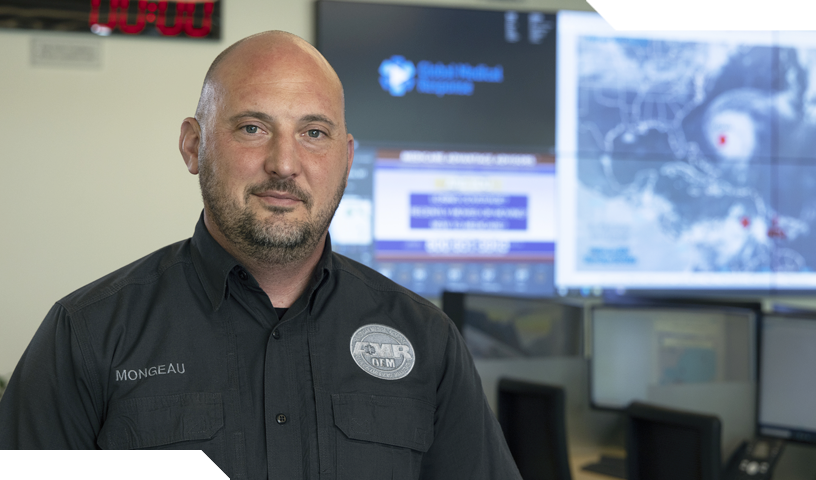
In disaster response, whether in the field or at our National Command Center, communication is everything. If we can't communicate, we can't do what we need to do. That could be serving our local communities or communicating to our own team. So everything we have here at the National Command Center at GMR must be redundant – whether it’s voice or data communications or power.
And that’s why we’re on FirstNet®.
The Office of Emergency Management at GMR serves as the national medical transport contractor for the federal government. So, its primary function is in support of that contract. Anytime there's a significant national event, we bring it up.
We have a fulltime team that leads each of our sections. And we bring in additional leadership from across the country so we can provide a complete leadership team for any disaster or emergency we might face.
From our command center to our field bases, we must have the same capabilities. First, to communicate with us in the National Command Center, but then, amongst themselves and to the state, federal, and local partners there.
Without communication, there's not a lot that we as a leadership team or as a company can do to ensure we accomplish our mission effectively and efficiently.
Fortunately, emergency medical care to a patient can always happen – thanks to our top-tier providers. But if we lose communication, we're left to figure things out on our own. So communication is the key to everything we do.
Using photo and video to paint a picture
We can do a lot to try to paint a picture with words. But there's no replacement for seeing it for yourself. Pre-pandemic, there were efforts in emergency management to do video teleconferencing from the field. This would allow us to support our field-based staff better.
In this post-COVID world, we have to rely more and more on video capabilities to be able to see and communicate what's going on and how we can support each other. COVID really forced us to be much more remote. We couldn’t go to the field as much. And that really accelerated the use of video from the field.
During Hurricane Ida in September 2021, we staged in Gonzalez, Louisiana. That’s where our branch and our leadership and logistics team were. But we had teams across the area – from New Orleans to the parishes south and east of there.
As our branch chief would communicate the next place they were going, it typically got more and more austere. Being able to see those parishes south and east of Louisiana that were in a coastal zone made it that much easier for us to determine what we needed to provide as a national command center. Our ability to observe those conditions allowed us to keep our crews safe.
Priority and preemption capabilities
Here in the Dallas-Fort Worth metroplex, the FirstNet benefit is just the day-to-day priority and preemption our first responders get throughout the area. There's 7 million-plus people here in the Dallas-Fort Worth area. It's obviously a sports mecca. And we have many, many large sporting events, special events.
Emergencies and disasters don't care about a game schedule or whatever special event may be happening.
FirstNet gives us the confidence that whether it's just day-to-day traffic or texting or messaging, we can be ready for anything. We don’t have to compete with other users.
Being in a large urban area, it's not uncommon to have either slow bandwidth or not be able to get a message out. That's one of the significant day-to-day benefits of FirstNet – the ability to have that priority and, for first responders preemption. Or just the knowledge that it is there should I need it.
Many times we were unsure of coverage if we were at some soccer field or some event. But as AT&T has built out the FirstNet public safety network and platform throughout this area and throughout the country, that insurance we have as emergency responders, as disaster subject matter experts, is significant to us.
Hurricane Michael
In 2018, we activated for Hurricane Michael to the Panama City/Mexico Beach area of Florida. It was one of the more significant hurricane impact deployments. As that extended over time, the degradation in communication became very difficult.
That's one of the first times where our cellphone, our communications capabilities were essentially gone. Cellphone towers were down. It impacted everything to some degree or another.
From a National Command Center based in the Dallas-Fort Worth area, reaching out to the Florida Panhandle, there's only one way to talk to them. And if you lose that pathway, it becomes much more difficult.
During that event, we were able to find FirstNet in theater and reached out. Because we did not have FirstNet at the time, FirstNet provided us devices. And we were able to hand those out to our ambulance crews, to our command staff, to bring communications back up.
We were running missions throughout that impact area. We were doing wellness checks, making sure people were safe and secure. We were providing transport in a 9-1-1 environment throughout the area. So, we were there for several weeks post-impact, supporting the area, and were able to use those devices throughout.
That’s really our first experience in a deployment, in a disaster area, with FirstNet and that capability.
I would say from the time we handed devices out, or we made contact with FirstNet, to when we were able to reestablish communication was within the hour. It's just pretty seamless once you have a FirstNet-capable device.
That's obviously one of the more extreme examples we've had and our first experience with FirstNet.
FirstNet through the Pandemic
Throughout the pandemic, we deployed hundreds of ambulances and personnel to New York City. We deployed hundreds of ambulances to New Jersey throughout the state. We had over 100 task orders throughout the pandemic where we sent ambulances and personnel throughout the country.
If you don't have national coverage, you run into the same challenges with density. So our ability to have prioritized access on the FirstNet network was significant. We ran thousands and thousands of calls with our partners there, in the state of New York and New York City.
We would hand out a FirstNet device, a phone, to each ambulance, each pair, and to the command staff and incident management team that come out.
We maintain over 1,200 handheld FirstNet devices in our cache. And we give those to everybody coming in. With them, we can get voice and text messages, share images and video, get data and track location in near real-time.
We also use Cradlepoint routers. We have our own FirstNet LTE systems on our command trucks. And we’ve exercised them significantly, over the last two-and-a-half years – from Hurricane Ida and Hurricane Laura and Covid, throughout the country.
Peace of mind
As the deputy incident commander, I’m in charge of implementing the strategies and missions from my incident commander. And I lose sleep at night worrying about what might happen, what this storm might do to us, and what we need to be ready for.
Without a communications system specific to public safety, I would have many more sleepless nights. So, the insurance that our leadership has the ability to connect quickly and efficiently with the FirstNet teams across the country, is a significant capability for us.
Our experience, from an operations perspective has always been great with the personnel on the FirstNet teams. Whether it's receiving priority service or contact or helping us understand or correct challenges we may be seeing in the field. We’ve always had great service and great relationships with the FirstNet team throughout our time here at GMR.
There's a growing pride in knowing that I’ve got a phone in my back pocket that's special, that can give us that capability and that there's a team that's specific to us and that is speaking to us. There's some exclusivity there. There’s some pride in that – a growing pride in having a capability and a team that supports us that way.
Safer communities
It's unequivocally safer having FirstNet capability in our country. I live in a suburb with soccer moms and dads. At the end of the day, I want my ambulance and my firetrucks and my police and my emergency managers to be able to communicate to come support my family.
From the frontlines in our communities to hurricanes like Michael and anything else that may come, it absolutely contributes to a safer community and a safer country.
Ultimately, our ability to have these communications keeps our communities safer, keeps us able to safely support our cities, counties, states, and our federal government.
Phillip Mongeau is the national director of emergency management for Global Medical Response. With over 20 years of experience serving public safety, he executes on the mission and strategies of the Office of Emergency Management at Global Medical Response. And he leads deployments out of GMR’s National Command Center in the Dallas area. He also functions as the deputy incident commander.