Building where public safety needs us most
September 16, 2026
Key points
FirstNet takes feedback from public safety and turns it into real, tangible network enhancements in ways that commercial networks do not.
The FirstNet Authority then authorizes investments in new purpose-built sites, and AT&T then gets to work turning those plans into reality, integrating each site into the network.
Recent purpose-built cell sites are a clear example of how the FirstNet model works. Public safety identifies a need and the FirstNet Authority helps ensure ongoing investments are targeted where they'll have the greatest impact.
I've spent nearly a decade helping to build FirstNet®, Built with AT&T and if I could describe in simple terms what sets FirstNet apart from commercial networks, it’s this: We start with the people, not the technology.
Time and again, I've heard first responders tell us about a stretch of highway where connectivity drops, a rural community that's hard to reach, or a disaster-prone area where reliable communication can make all the difference. The beauty of FirstNet is that these conversations don’t just go into a suggestion box that no one reads. We take feedback from public safety and turn it into real, tangible network enhancements in ways that commercial networks do not—all in partnership with the First Responder Network Authority (FirstNet Authority), the independent agency that oversees the buildout, deployment and operation of America’s public safety network.
Addressing coverage needs
The purpose-built FirstNet cell site is an excellent example of that partnership and expertise in action. When we talk about a purpose-built cell site, we're talking about more than a new tower on the landscape. These are sites built specifically to address coverage needs identified by public safety, each one strengthening and expanding what is already the nation's largest network built for public safety.1
First, we start with listening. Through coverage enhancement workshops and ongoing conversations with agencies across the country, the FirstNet Authority gathers feedback directly from the people working on the front lines. That input, combined with real-world data and analysis, helps identify places where additional coverage could make a meaningful difference. The FirstNet Authority then authorizes investments in new purpose-built sites, and AT&T then gets to work turning those plans into reality: identifying locations, navigating permitting, constructing the site, and integrating each site into the network.
It's a model that's fundamentally different from the way most networks grow. The driving force isn't population density or commercial demand. It's public safety need.
The FirstNet Authority has now authorized more than 350 new purpose-built FirstNet sites to be built across every state in the coming years.
The model in action
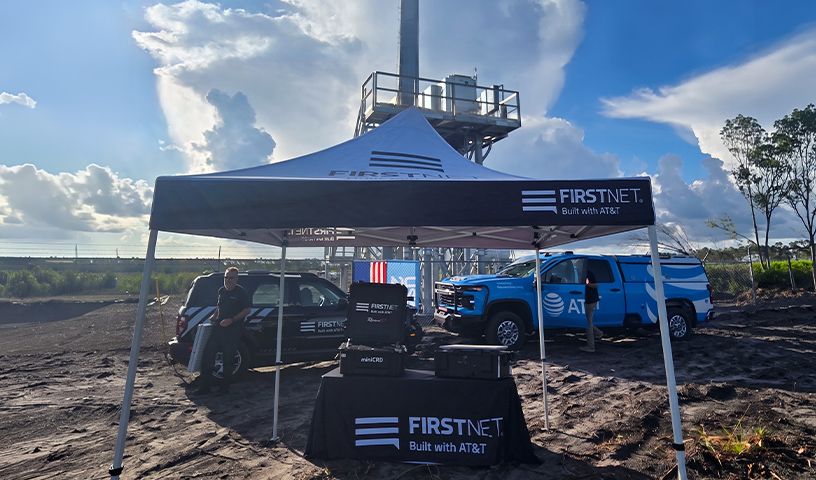
To celebrate this model in action, I recently visited Horseshoe Beach, Florida.
For years, first responders in the area faced connectivity challenges, particularly during hurricane response. Local public safety agencies raised those concerns, and through the FirstNet process, the need was identified and addressed. Today, a new, purpose-built 5G cell site is helping strengthen communications for first responders operating in and around the community.
This site in Horseshoe Beach also kicked off our most recent efforts with the FirstNet Authority to expand the FirstNet network. Following an initial authorization last year for more than 135 sites and a recently approved task order for more than 220 additional sites, the FirstNet Authority has now authorized more than 350 new purpose-built FirstNet sites to be built across every state in the coming years. We recently saw this effort continue in Calaveras County, California and Brantley County, Georgia, where purpose-built sites have come online to support the needs of local public safety. We expect to have sites live across 8 states for public safety by the end of this year.
For me, Horseshoe Beach represents something bigger than a single tower. It's a clear example of how the FirstNet model works. Public safety identifies a need. The FirstNet Authority helps ensure ongoing investments are targeted where they'll have the greatest impact. AT&T brings the engineering expertise and scale to build and operate the infrastructure. Together, those capabilities produce results that help first responders stay connected when it matters most.
A shared mission
Purpose-built sites demonstrate what can happen when first responders, government accountability and private-sector innovation work toward a shared mission.
As technology evolves and public safety's needs continue to change, that mission won't stop. First responders will need access to new capabilities, stronger connectivity and the latest technologies that help them protect lives and communities. That's exactly why FirstNet was created, and why it continues to matter today.
When I look at places like Horseshoe Beach, I don't just see a new tower. I see a community that is better connected. I see first responders who have another tool they can rely on during an emergency. And I see proof that when public safety has a seat at the table, we can build a network that's stronger, more resilient and better prepared for the moments that matter most.
1. Compares ground-based cellular networks.