FirstNet Empowers the Era of the ‘Connected Responder’
April 14, 2026
Key points
- Today, a growing ecosystem of technology is enhancing first responders’ situational awareness of emergencies and keeping their teams—and our communities—safer.
- As public safety’s network partner, FirstNet®, Built with AT&T is the only provider required by the federal government to innovate for first responders.
- Even before an emergency strikes, public safety is working behind the scenes to keep resources and critical infrastructure prepared so teams stay mission-ready.
For decades, public safety connectivity was largely restricted to radios that linked responders in the field to dispatchers who often had limited visibility of the scene. Today, a growing ecosystem of technology is enhancing first responders’ situational awareness of emergencies and keeping their teams—and our communities—safer.
But in this new era of the connected responder, new capabilities bring new requirements. More devices mean more data, and wearables, cameras, drones and asset trackers all need a network that is dependable when it’s needed the most.
As public safety’s network partner, FirstNet®, Built with AT&T is the only provider required by the federal government to innovate for first responders. As a part of that mandate, we developed the FirstNet IoT Embedded Program, which helps public safety technology companies integrate FirstNet IoT connectivity directly into solutions. The impact is real—thanks to the more than 75 companies that work with this program, more than 2 million connections on FirstNet are connected devices, which ultimately helps enhance first responders’ situational awareness at every step of their emergency response.
On scene insight for faster, safer response
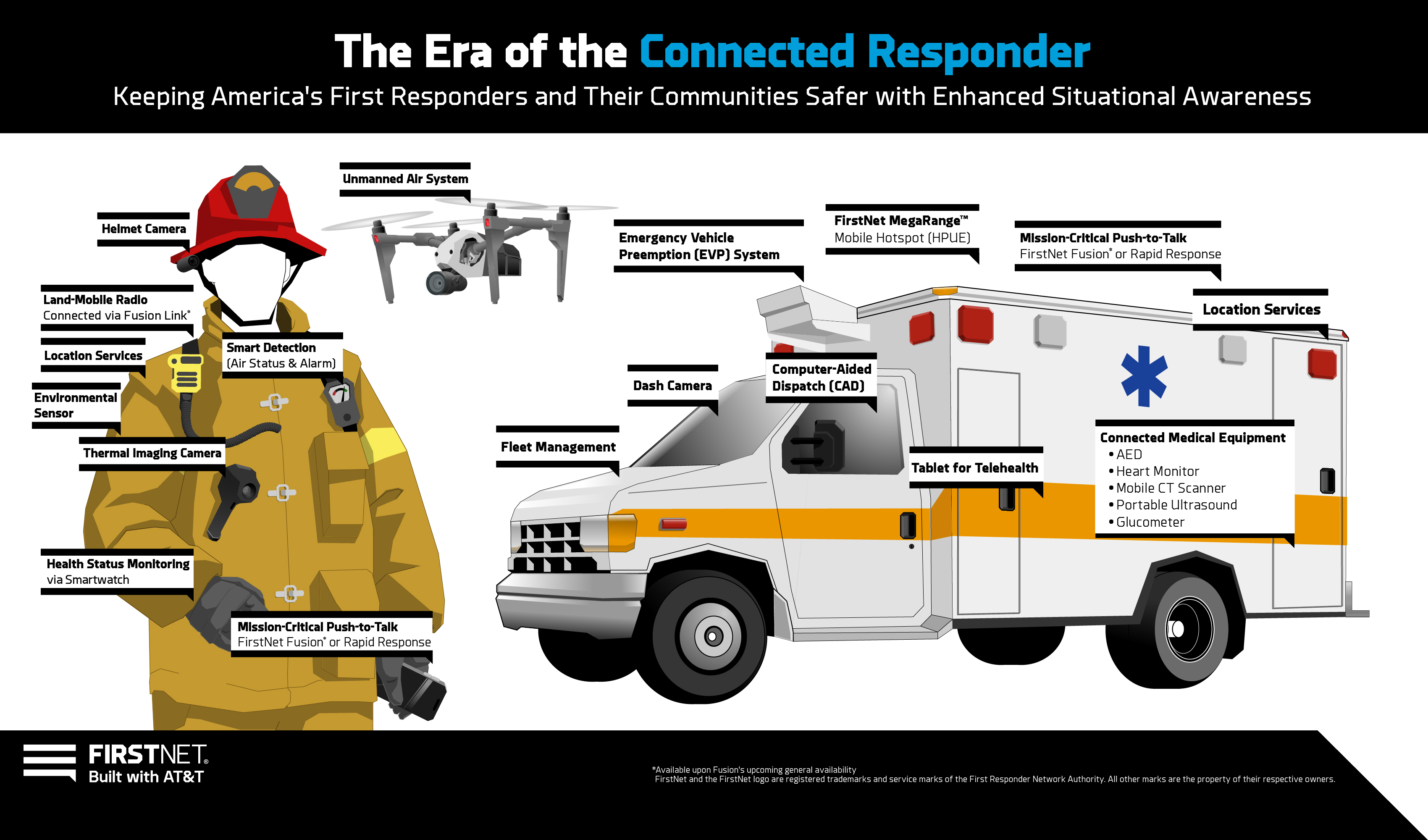
Imagine a team of first responders at a high-impact, multi-vehicular collision. As passers-by dial 9-1-1, operators using NextGen 9-1-1 solutions like AT&T ESInet are able to seamlessly receive pictures, videos and automatic crash alerts to triage the incident. Simultaneously, connected fleet management trackers monitor the location of nearby police vehicles, automatically dispatching the closest units to ensure the most rapid response.
Once on the scene, police wearing body cameras—like the FirstNet Trusted™ Axon Body 4—begin to collect evidence, while firefighters assess the situation with thermal imaging cameras and environmental sensors that monitor heat or chemical exposure. Wearables like smartwatches and vests track their biometrics—keeping tabs on their heart rate, blood oxygen levels and more. This helps ensure that teams stay safe while in the field.
Newer technology like unmanned air systems from Archer FRS are also solving long-standing issues by giving 9-1-1 operators, EMS and fire agencies the ability to deliver life-saving medical equipment directly to a scene.
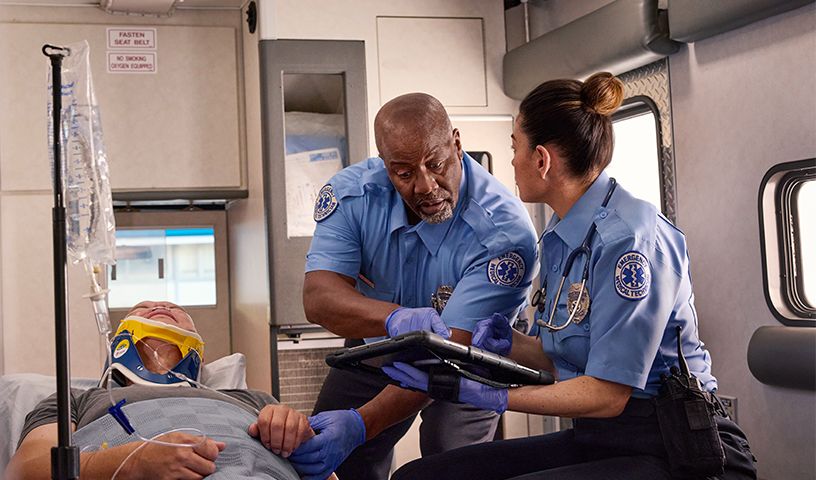
And as soon as a patient is loaded into an ambulance, paramedics are able to send the hospital critical patient telemetry through an arsenal of tools like AEDs, portable ultrasounds and CT scanners, and glucometers. By monitoring vital signs, delivering diagnostic imaging and providing an estimated arrival, these FirstNet-connected devices mean emergency rooms can prepare critical resources in advance and save precious minutes triaging once the patient arrives.
As emergency response evolves, FirstNet will continue to evolve with it, keeping first responders connected across all devices—no matter its mission.
Readiness for every mission
Even before an emergency strikes, public safety is working behind the scenes to keep resources and critical infrastructure prepared, so teams stay mission-ready.
For emergency management departments, preparing for a disaster is a year-round job—and these teams are turning to connected solutions to have equipment ready to go when the time calls for it. Devices like the FirstNet Trusted™ BeMini can monitor the location, temperature and humidity levels of critical supplies like a cache of emergency medicine. Agencies are also charging, prepping and storing tablets, asset trackers and other FirstNet Ready® devices in case of deployment. And with the FirstNet IoT Control Center, departments can turn the individual SIMs of these devices on and off depending on need—a cost effective way for devices that are only used during large-scale emergencies to be easily turned on when needed.
Connectivity is critical for every responder in every emergency, and as newer technology becomes more integrated into public safety’s response efforts, we know that FirstNet needs to be at the heart of their operations. That’s why our team is working hand-in-hand with public safety design FirstNet to suit their present and future needs.
Even beyond the network, we knew that we needed to create a broad communications infrastructure that understands public safety’s need for these types of devices. Our new mission critical push-to-talk platform, FirstNet Fusion, is laying the foundation to integrate existing and future ecosystems into a one-stop-shop for public safety communications. Designed to allow first responders to easily coordinate across virtually any device, radio system or carrier, Fusion’s open platform will also serve as a basis for future connections to other public safety technology. This includes the ability to integrate situational awareness platforms such as Axon Fusus to provide direct access to information like body camera footage and locational data to increase response visibility in the field.
It’s been 9 years since we first partnered with the federal government to deliver FirstNet. And this commitment to innovation is only possible because of this successful public-private partnership, making America a leader and public safety a national priority. It strengthens our ability to hear and learn from public safety’s real-life experiences. Without that close tie, we would not be able to build a multi-layered network that is truly for first responders. And as emergency response evolves, FirstNet will continue to evolve with it, keeping first responders connected across all devices—no matter its mission.